

- Published by:
- Department of Government Services
- Date:
- 28 Oct 2026
The report provides a snapshot of Social Procurement Framework achievements over time and demonstrates the difference each government procurement can make to the lives of Victorians and Victorian communities.
It also sets a baseline to measure social procurement achievements in the future.
Acknowledgments
Victoria’s Social Procurement Framework was developed by the Department of Government Services. A range of departments and agencies across government contribute to the Social Procurement Framework annual report each year.
From 1 January 2023, all functions relating to the Social Procurement Framework are coordinated by the Department of Government Services. Ingrid Stitt is the responsible Minister for the framework in her capacity as the Minister for Government Services.
Language statement
We recognise the diversity of Aboriginal people living in Victoria. We use the term ‘Aboriginal Victorians’ to include Victorian Traditional Owners, clans, family groups, and all other Aboriginal and Torres Strait Islander descendants living in Victoria. The term ‘Aboriginal community’ includes Traditional Owners, business owners and other community representatives.
‘Department’, ‘we’ or ‘our’ are referring to the Department of Government Services/Victorian government.
Disclaimer
This publication may be of assistance to you, but the State of Victoria and its employees do not guarantee that the publication is without flaw of any kind or is wholly appropriate for your particular purposes and therefore disclaims all liability for any error, loss or other consequence which may arise from you relying on any information in this publication.
Accessibility
We have provided as much of this annual report in HTML as practicable.
If you would like to receive this publication in an accessible format, please telephone 03 7005 9138 or email: buyingforvictoria@dgs.vic.gov.au.
About the Social Procurement Framework in 2024-25
Review the key highlights that shaped our year.
Victorian Government procurement is one of the largest drivers of the Victorian economy. Value for money is the key consideration underpinning all Victorian Government procurement decisions. The Social Procurement Framework (the Framework) ensures value-for-money considerations are not solely focused on price but encompass opportunities to deliver social and sustainable outcomes that benefit the entire Victorian community. In this way, the Framework helps government create economic benefit and jobs for all Victorians.
Social procurement objectives and summary of priorities
The Framework is used by more than 260 government departments and agencies1 to identify their social and sustainable procurement goals. These goals are detailed in the agency’s Social Procurement Strategy or Plan and will often align with other government strategies, priorities and initiatives. Departments and agencies report on progress towards their social and sustainable procurement goals in their respective annual reports and contribute to the whole-of-government report.
[1] This refers to government departments and agencies subject to the Standing Directions 2018 under the Financial Management Act 1994 as at January 2023.
Highlight achievements
Achievements since the launch of the Framework in 2018
Since 2018, Victorian Government departments and selected large agencies2 have continued to directly invest in Victoria’s social benefit suppliers with expenditure of:
- $204.37 million with certified Victorian Aboriginal businesses3
- $143.52 million with certified Victorian social enterprises4
Achievements in this reporting period (1 July 2024–30 June 2025)
Victorian Government departments and selected agencies have directly spent:
- $56.17 million with 118 certified Victorian Aboriginal businesses.
- $27.89 million with 98 certified Victorian social enterprises. Of this, $316,833 was spent with 6 certified Victorian social enterprises led by a mission for job readiness and employment of Victorian priority jobseekers.
- $5.1 million with 34 Australian Disability Enterprises or social enterprises led by a mission for people with disability.
In 2024–25 the direct spend of 150 additional Victorian Government agencies has been collected. These agencies have directly spent:
- $25.31 million with certified Victorian Aboriginal businesses.
- $50.45 million with certified Victorian social enterprises including $1.33 million spent with certified Victorian social enterprises led by a mission for job readiness and employment of Victorian priority jobseekers.
- $7.82 million with Australian Disability Enterprises or social enterprises led by a mission for people with disability.
[2]Departments and agencies included are Department of Energy, Environment and Climate Action (DEECA), Department of Education (DE), Department of Families, Fairness and Housing (DFFH), Department of Government Services (DGS), Department of Health (DH), Department of Justice and Community Safety (DJCS), Department of Jobs, Skills, Industry and Regions (DJSIR), Department of Transport and Planning (DTP), Department of Premier and Cabinet (DPC), Department of Treasury and Finance (DTF), Victoria Police, Victorian Infrastructure Delivery Authority (VIDA) formerly, Major Transport Infrastructure Authority (MTIA) and CenITex.
[3]Certified Aboriginal businesses refer to Victorian Aboriginal businesses that are certified by Kinaway or Supply Nation. For the 2023-24 reporting period, only spend with Victorian Aboriginal businesses certified by Kinaway or Supply Nation has been reported to ensure alignment with the Framework definitions.
[4]Certified Victorian Social Enterprises refers to organisations that are certified by Social Traders and operate and have business premises in Victoria. A policy change discontinued use of the Map for Impact database as a source to identify and verify social enterprises. The Map for Impact will no longer be included under the operational definition of ‘social enterprise’ for Framework purposes.
Opportunities for Victorian Aboriginal people
Find out how the Government supports Victorian Aboriginal people to participate in government procurement.
The Opportunities for Victorian Aboriginal people objective focuses on generating employment and economic prosperity by purchasing from Victorian Aboriginal businesses and purchasing from suppliers employing Victorian Aboriginal people.
Direct spend with certified Aboriginal businesses varies year-on-year, reflecting the varying needs of Government over time.
Chart 1: Direct spend with certified Aboriginal Businesses between 2018–19 and 2024–25
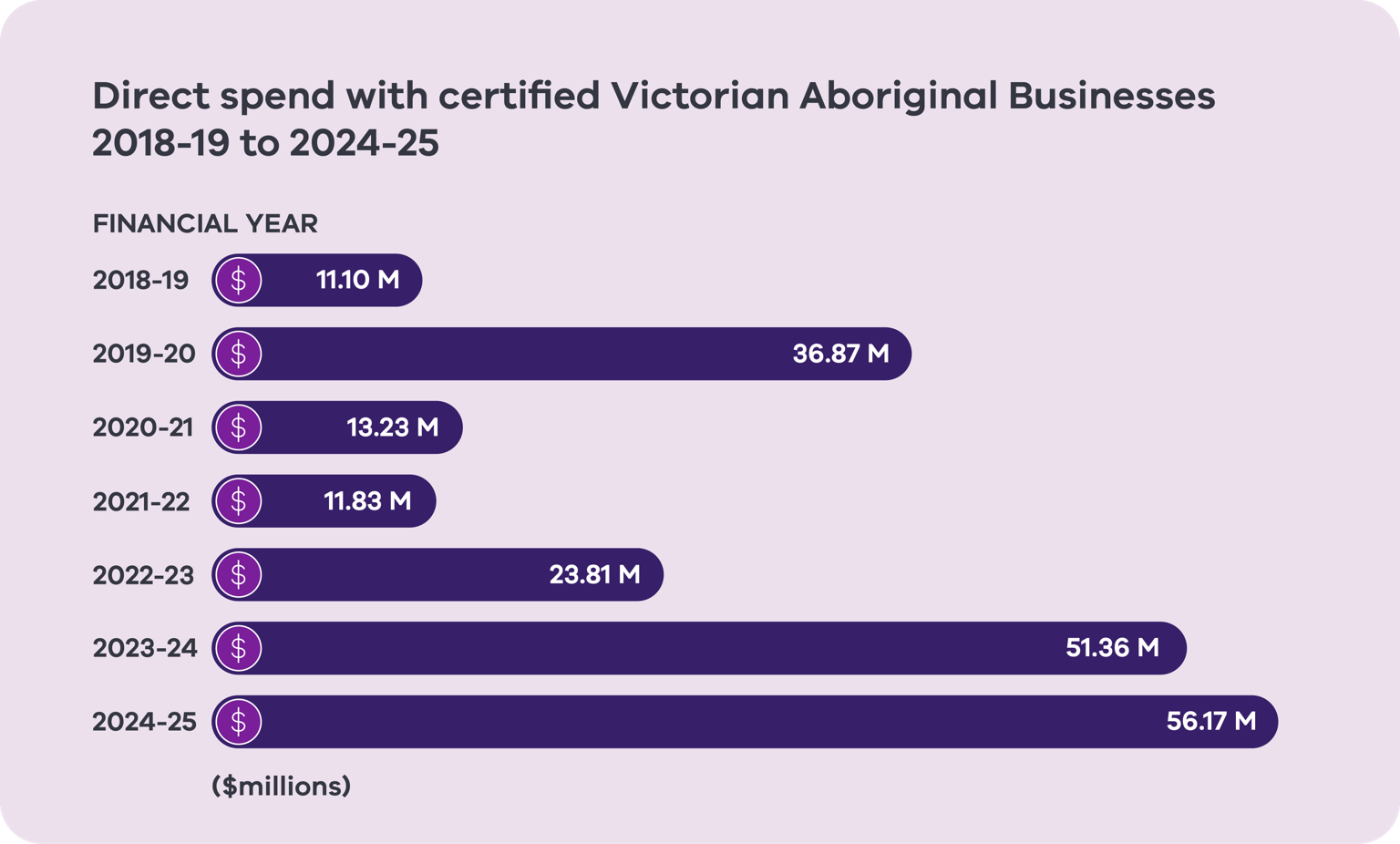

*Note: The increase in FY2019–20 is attributed to COVID-19 related-spending.
Opportunities for Victorian priority jobseekers
Learn about how the Government is helping Victorians experiencing disadvantage with meaningful employment opportunities.
On 1 July 2023, the Opportunities for disadvantaged Victorians objective was replaced with the Opportunities for Victorian priority jobseekers objective.
The revised objective supports improved implementation of the SPF and Victorian Government priorities. This will also be more inclusive of participants/clients of services across government.
A Victorian priority jobseeker must be one of the following:
- long-term unemployed (unemployed for 12 months or more)
- at risk of long-term unemployment:
- working less than 12 hours per week in casual, temporary, or intermittent work
- experiencing employment barriers (e.g. not completing secondary education, low English language proficiency)
A young person aged 15 to 24, is also a considered a priority jobseeker if:
- unemployed
- working less than 12 hours in casual, temporary, or intermittent work
- not in full time study
Chart 2: Direct spend with certified social enterprises led by a mission for job readiness and employment of Victorian priority jobseekers in 2024–25
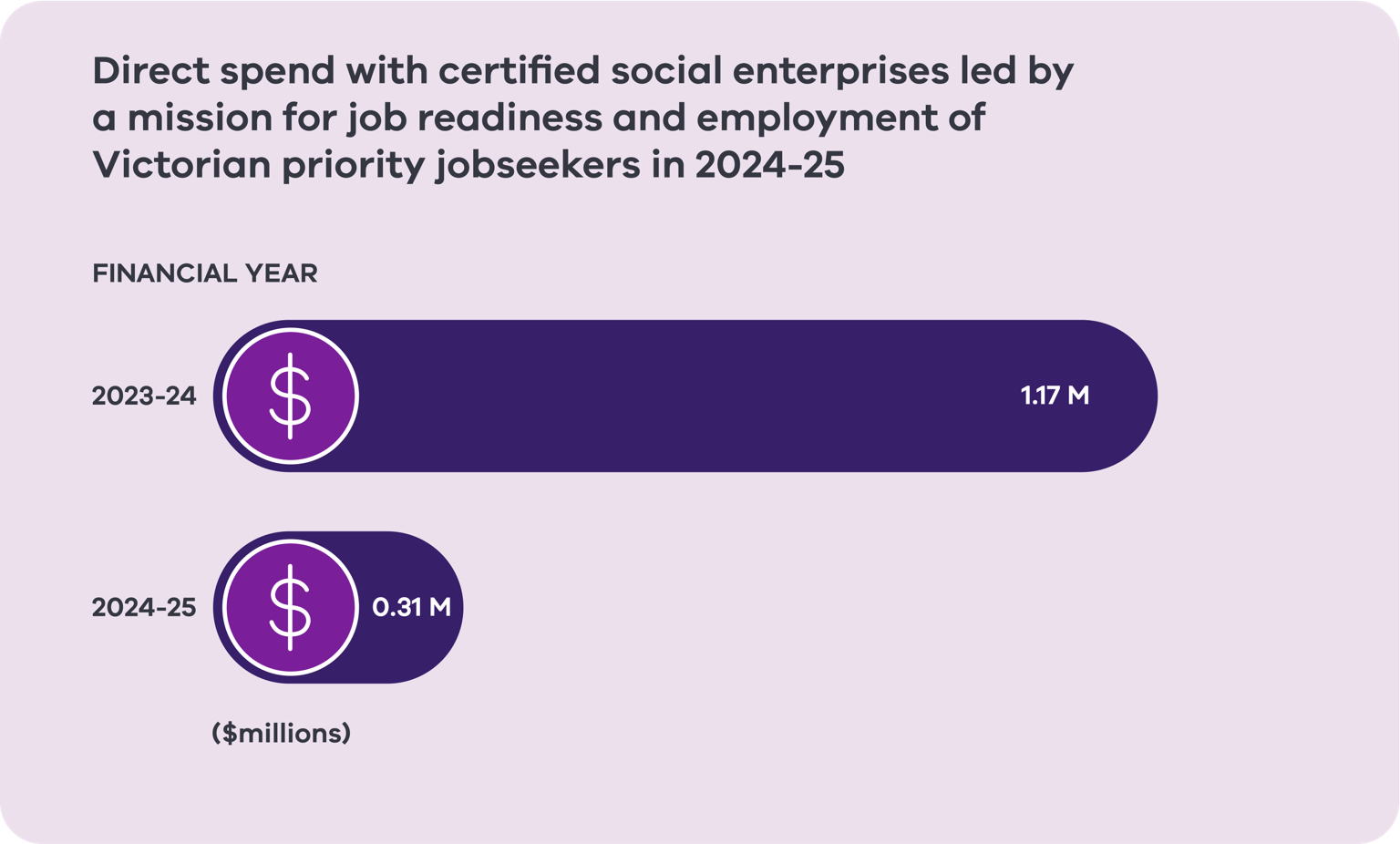

*Note that this objective was not measured prior to 2023–24.
Opportunities for Victorians with disability
Creating jobs for people with disability through purchasing from Australian Disability Enterprises and relevant social enterprises.
The Opportunities for Victorians with disability objective aims to help ensure all Victorians can participate fully in dignified work. This objective aims to create jobs for those with disability through purchasing from Australian Disability Enterprises and social enterprises with a mission to support people with disability, as well as purchasing from Victorian Government suppliers directly employing people with disability5.
Chart 3: Direct spend with Australian Disability Enterprises and certified social enterprises led by a mission for people with disability between 2018–19 and 2024–25
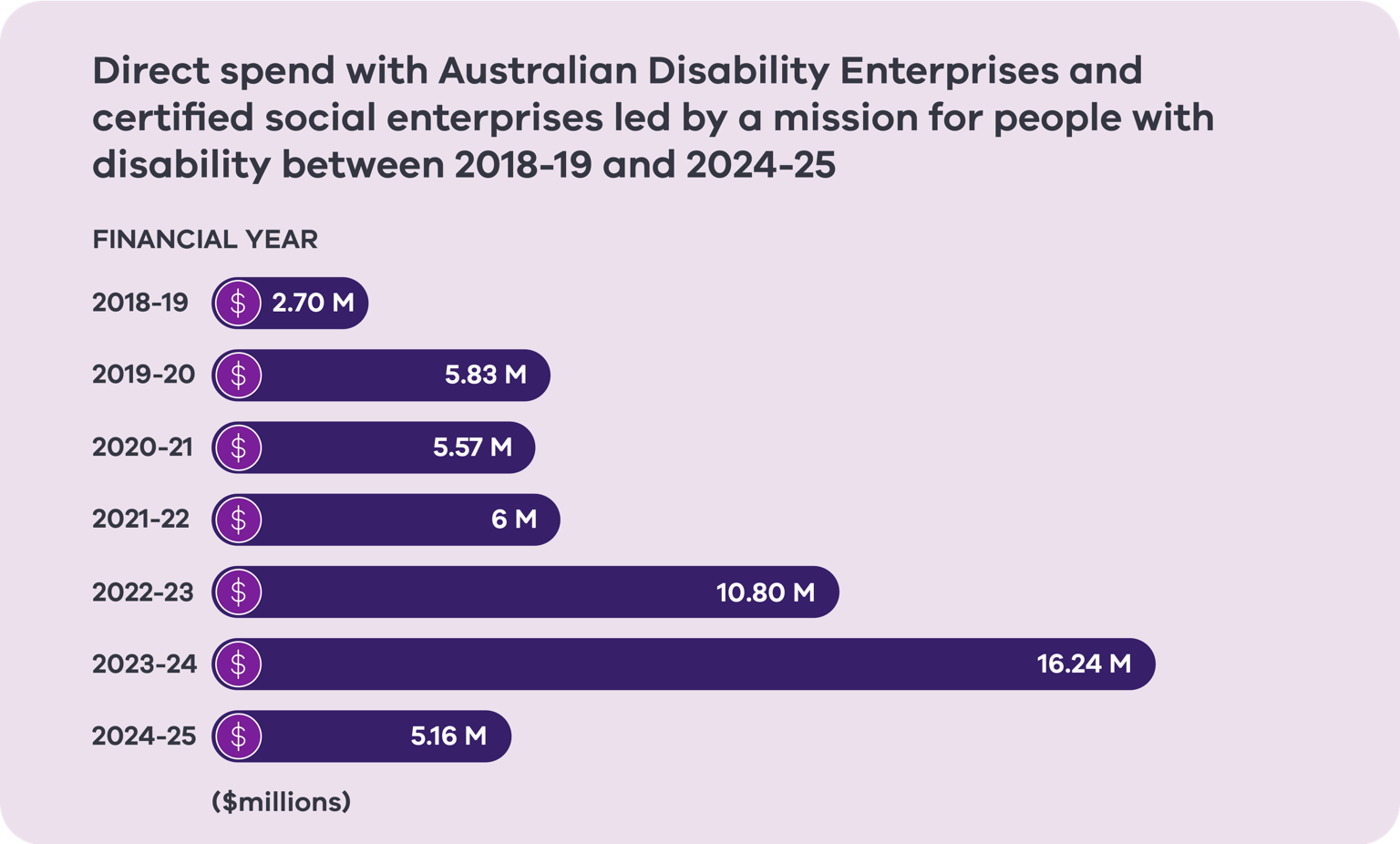

*Note: The drop in spend in FY2024–25 is primarily attributed to fluctuations in spend on government initiatives and long-term contracts ending.
[5] In 2018-19, data for this cohort was collected between January and June 2019 only.
Sustainable Victorian social enterprise and Aboriginal business sectors
Victorian social enterprises and Aboriginal businesses play an important role in driving employment participation and inclusive economic growth.
The Sustainable Victorian social enterprise and Aboriginal business sectors objective directs spending toward social enterprises and Aboriginal businesses, helping ensure they remain financially sustainable and to support vibrant and inclusive economic growth6.
Chart 4: Direct spend with certified Victorian Social Enterprises between 2018–19 and 2024–25
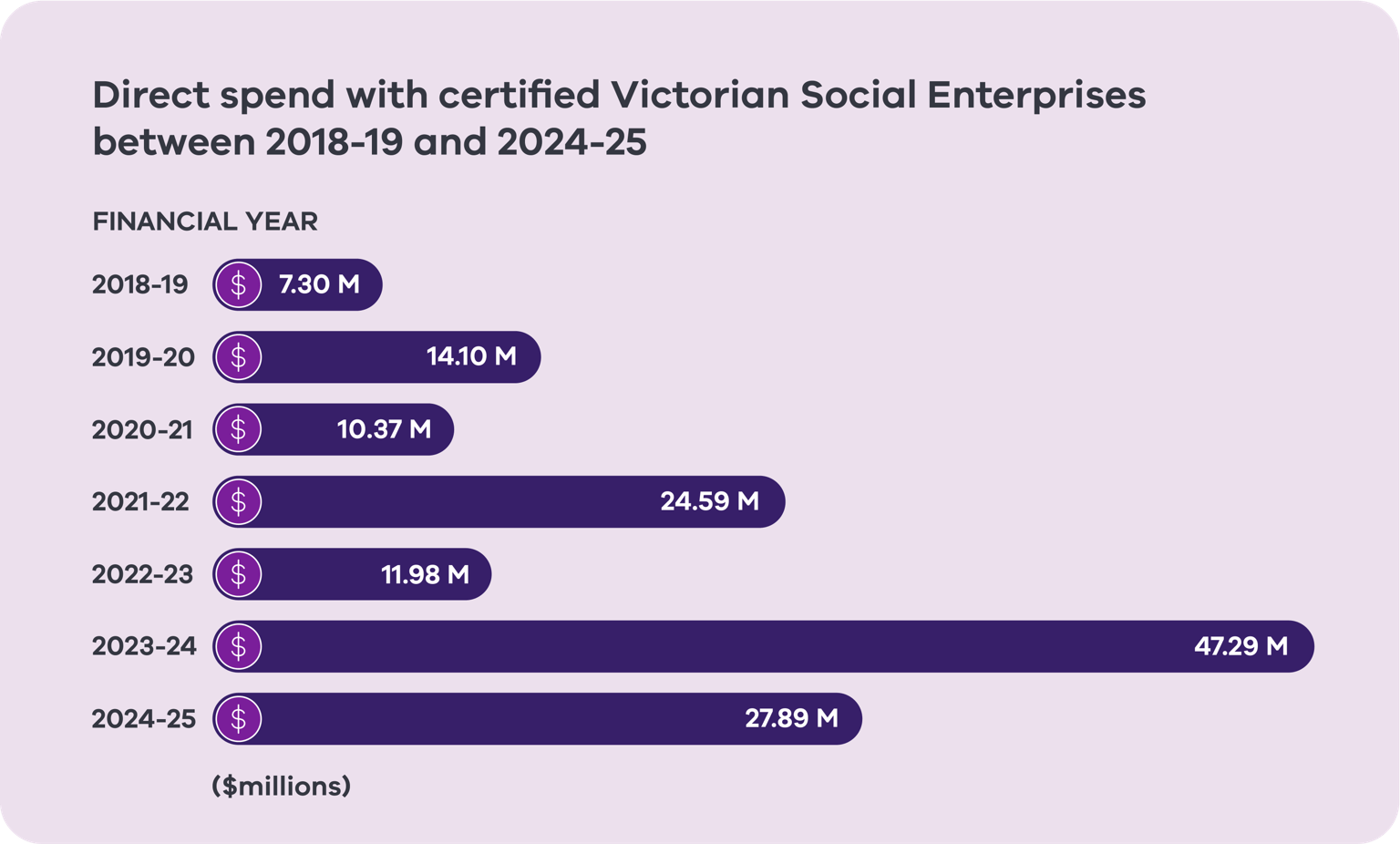

For Direct Spend with verified Aboriginal Businesses between 2018–19 and 2024–25, see: Opportunities for Aboriginal Victorians.
*Note: The increase in spend in FY2023–24 is primarily attributed to fluctuations in spend on government initiatives.
[6] In 2018-19, data for this cohort was collected between January and June 2019 only.
Victorian government agency achievements under the SPF in 2024-25
Read about the Victorian government agency achievements under the SPF in 2024-25.
In 2024-25 the direct spend of 150 additional Victorian Government agencies that are subject to the Standing Direction 2018 under the Financial Management Act 1994 has also been captured for each SPF objective.
Chart 5: Victorian government agencies direct spend with certified social benefit suppliers in 2024–25
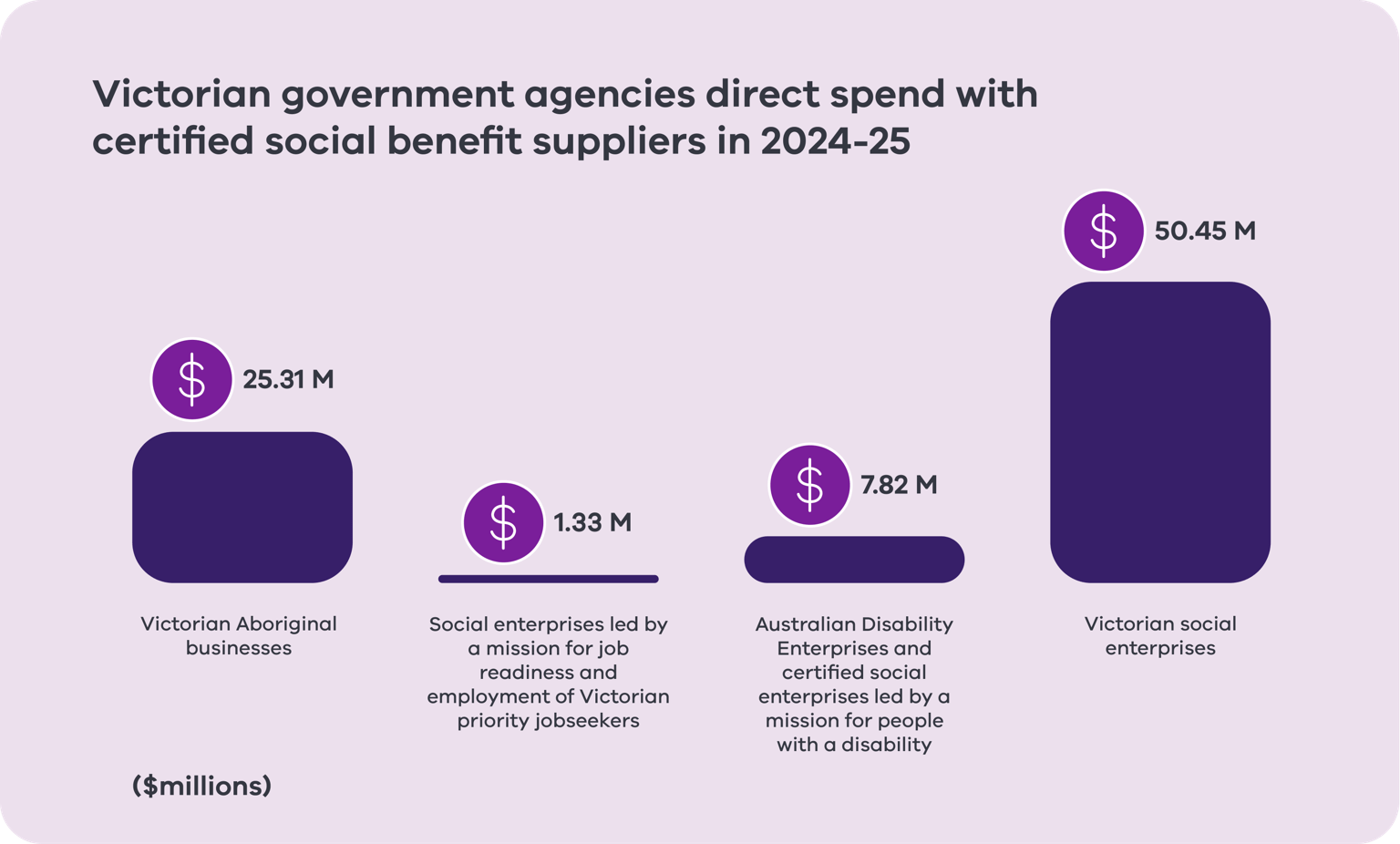

For a list of the 150 agencies included in the above table, see: Appendix 1 - Victorian Government agencies included in Chart 5.
How suppliers work with the Framework
Understand the role suppliers play in social procurement.
There are 2 types of government suppliers: social benefit suppliers and mainstream suppliers.
A social benefit supplier operates and has business premises in Victoria and meets one or more of the following criteria:
- is a social enterprise certified by Social Traders
- is an Australian Disability Enterprise providing ‘supported employment services’ as defined in s. 7 of the Disability Services Act 1986 (Cth)
- is a Victorian Aboriginal business, certified by Supply Nation or Kinaway
To count an engagement in its social procurement activity reports, a department or agency must ensure the social benefit supplier is certified.
A mainstream supplier is any supplier that is not a social benefit supplier.
Direct and indirect social procurement
The Victorian Government delivers social and sustainable outcomes through both direct and indirect social procurement. Government buyers should consider opportunities to deliver social and sustainable outcomes as part of every procurement activity.
Delivering direct procurement, departments or agencies undertake a Victorian Government procurement process or use an established SPC to purchase goods, services or construction from a certified social benefit supplier.
When it comes to indirect procurement, departments or agencies purchase goods, services or construction from a mainstream supplier using invitations to supply and clauses in contracts to deliver social and sustainable outcomes. This can include subcontracting social benefit suppliers in supply chains.
What suppliers need to demonstrate
When making purchasing decisions under the Framework, government buyers must apply the same due diligence for social benefit suppliers as they would for mainstream suppliers. They should consider whether certified social benefit suppliers:
- are suitably qualified
- demonstrate experience and have a proven track record
- have the capacity and scale to deliver the requisite work
- comply with mandatory government agency contract terms
- comply with all relevant industry standards, regulations and legislation
- are competitively priced
- have business practices that align with the Framework, such as a corporate social responsibility policy, gender or disability action plans or engagement with social benefit suppliers.
Social procurement benefits suppliers
The Framework integrates positive social and environmental outcomes with core business. The ability to demonstrate these outcomes makes suppliers more competitive when bidding for government work.
It also helps to foster workplace diversity, capability and productivity and contributes to innovative solutions for complex social, economic and environmental problems.
Find out more
Discover more about social procurement.
More information for government buyers and suppliers about the Social Procurement Framework can be found on the Buying for Victoria website.
Recycled First is a Victorian Government policy that requires bidders on government road and rail projects to demonstrate how they will optimise the use of sustainable products.
Sustainability Victoria’s Buy Recycled directory helps you find products with recycled content.
Business Victoria also has information on selling to government.
Appendix 1 - Victorian Government agencies included in Chart 5
- ACMI
- Adult Community and Further Education Board
- Adult Multicultural Education Services (AMES Australia)
- Albury Wodonga Health
- Alexandra District Health
- Alfred Health
- Ambulance Victoria
- Arts Centre Melbourne
- Australian Grand Prix Corporation
- Barwon Water
- Bass Coast Health
- Bendigo Health
- Bendigo Kangan Institute
- Benalla Health
- Boort District Health
- Box Hill Institute
- Building and Plumbing Commission
- Casterton Memorial Hospital
- Central Highlands Rural Health
- Central Highlands Water
- Chisholm Institute
- Cladding Safety Victoria
- Cohuna District Hospital
- Colac Area Health
- Coliban Region Water Corporation
- Corangamite Catchment Management Authority
- Corryong Health
- Country Fire Authority (CFA)
- Court Services Victoria
- Development Victoria
- Dhelkaya Health
- Dhelkunya Dja Wurrung Land Management Board
- East Gippsland Catchment Management Authority
- East Gippsland Region Water Corporation
- Eastern Health
- Echuca Regional Health
- Emergency Services Superannuation Board
- Energy Safe Victoria
- Environment Protection Authority (EPA)
- Essential Services Commission
- Fire Rescue Victoria
- Game Management Authority
- Geelong Arts Centre
- Geelong Cemeteries Trust
- Gippsland Southern Health Service
- Glenelg Hopkins Catchment Management Authority
- Goulburn Broken Catchment Management Authority
- Goulburn Ovens Institute of TAFE
- Goulburn Valley Health
- Goulburn-Murray Water Corporation
- Grampians Health
- Grampians Wimmera Mallee Water Corporation (GWM Water)
- Great Ocean Road Health
- Greater Western Water
- HealthShare Victoria (HSV)
- Heathcote Health
- Heywood Rural Health
- Inglewood and Districts Health Service
- Integrity Oversight Victoria
- Kardinia Park Stadium Trust
- Kerang District Health
- Kooweerup Regional Health Service
- Kyabram and District Health Services
- Labour Hire Licensing Authority
- Latrobe Regional Hospital
- Lower Murray Water
- Mallee Catchment Management Authority
- Mallee Track Health and Community Service
- Mansfield District Hospital
- Maryborough District Health Service
- Melbourne and Olympic Parks Trust (MOPT)
- Melbourne Arts Precinct Corporation
- Melbourne Market Authority
- Melbourne Polytechnic
- Melbourne Water
- Monash Health
- Moyne Health Services
- Museums Victoria
- Nathalia, Cobram and Numurkah (NCN) Health
- North Central Catchment Management Authority
- North East Catchment Management Authority
- North East Link State Tolling Corporation
- Office of Public Prosecutions
- Office of the Ombudsman
- Office of the Victorian information Commissioner
- Omeo District Health
- Oral Health Victoria
- Orbost Regional Health
- Parks Victoria
- Peninsula Health
- Peter MacCallum Cancer Institute
- Ports Victoria
- Queen Victoria Women's Centre Trust
- Remembrance Parks Central Victoria (Formerly Bendigo Cemeteries Trust)
- Robinvale District Health Services
- Rochester and Elmore District Health Service
- Royal Botanic Gardens Victoria
- Royal Children's Hospital
- Royal Melbourne Hospital
- Safe Transport Victoria
- SECV (VicPower)
- Seymour Health
- Shrine of Remembrance
- South East Water Corporation
- South Gippsland Water
- South West Healthcare
- South West Institute of TAFE
- Southern Metropolitan Cemeteries Trust
- Southern Rural Water
- State Sports Centres Trust
- Suburban Rail Loop Authority
- Sunraysia Institute of TAFE
- Surveyors Registration Board of Victoria
- Sustainability Victoria
- Swan Hill District Health
- TAFE Gippsland
- The Queen Elizabeth Centre
- The Royal Victorian Eye and Ear Hospital
- The Royal Women's Hospital
- Transport Accident Commission (TAC)
- Treasury Corporation of Victoria
- Triple Zero Victoria Emergency Services Telecommunications Authority
- Trust for Nature (Victoria)
- Tweddle Child and Family Health Service
- Veterinary Practitioners Registration Board of Victoria
- VicScreen
- Victoria Legal Aid
- Victoria State Emergency Service Authority
- Victorian Convention and Event Trust
- Victorian Electoral Commission
- Victorian Funds Management Corporation
- Victorian Health Promotion Foundation (VicHealth)
- Victorian Interpreting and Translating Services (VITS) LanguageLoop
- Victorian Managed Insurance Authority
- Victorian Pharmacy Authority
- VicTrack (Victorian Rail Track Corporation)
- Wannon Water (Wannon Region Water Corporation)
- West Gippsland Catchment Management Authority
- West Gippsland Healthcare Group
- West Wimmera Health Service
- Western District Health Service
- Western Health
- Westernport Region Water Corporation
- William Angliss Institute of TAFE
- Wimmera Catchment Management Authority
- Wodonga Institute of TAFE
- Workplace Injury Commission
- WorkSafe
- Yarra Valley Water Corporation
- Yea and District Memorial Hospital